

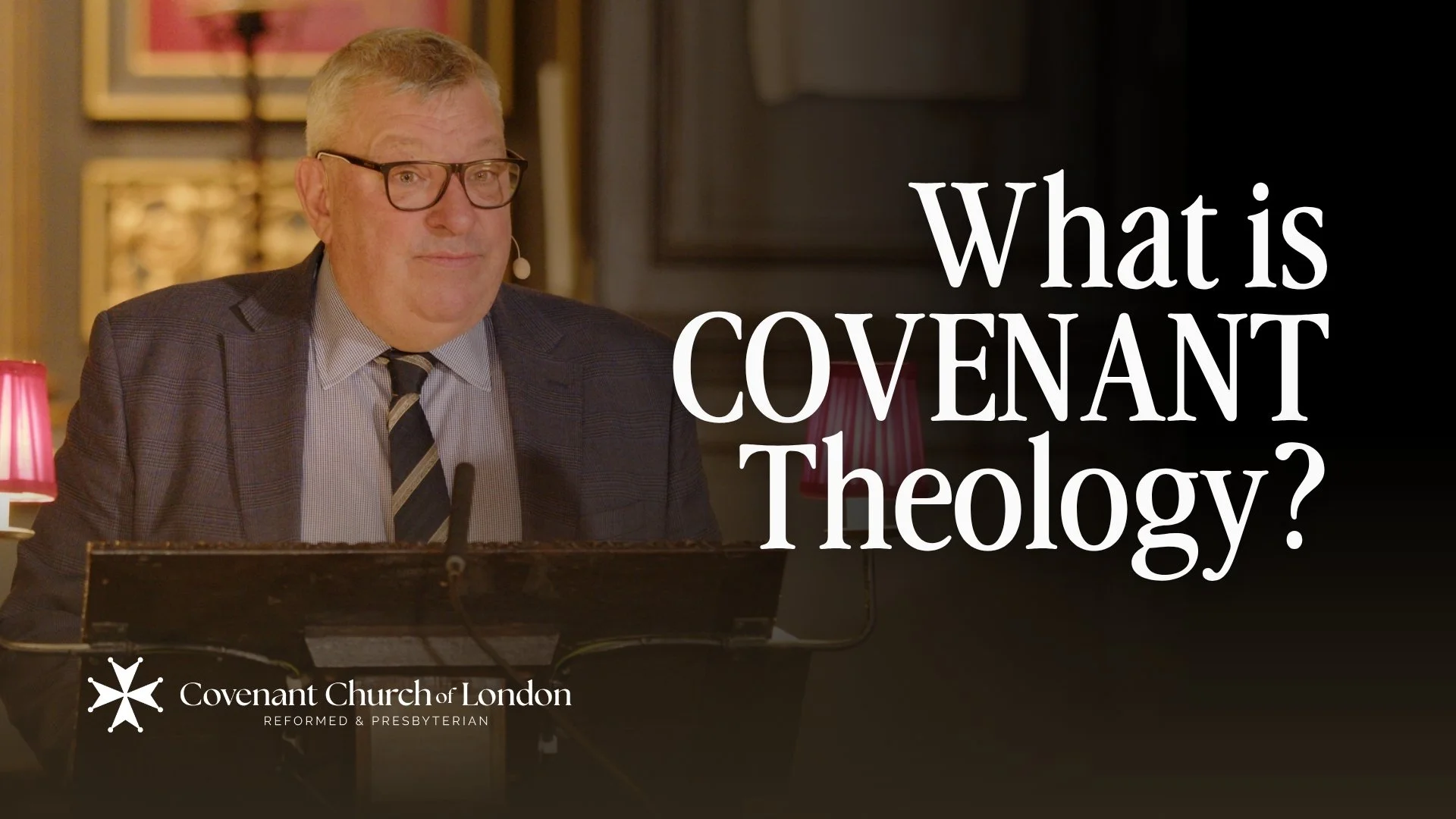
An Introduction to Covenant Theology
To comprehend Covenant Theology is to rightly interpret the Bible, according to the redemptive historical timeline of the Lord’s unfolding dealings with His people. Join Rev Dr Kevin Bidwell for this essential lecture on the biblical framework of grace, hosted by our Reformed Church in London.
This is a most important biblical subject to be taught to the church. It has been so neglected in England and the implications of it not being taught are wide-ranging. To comprehend covenant theology is to rightly interpret the Bible, according to the redemptive historical timeline of the Lord's unfolding dealings with His people. We can only have a relationship with the Living God on the basis of the covenants He lays down. Therefore, this is a vital subject, though we must never forget that covenants do not save us, it is our faith in the Lord Jesus Christ which saves us from our sins. As Augustus Montague Toplady penned in the hymn Rock of Ages: "Thou must save and thou alone".
It is interesting to note that during the early Reformation, the Anabaptists on the continent were challenging the Reformation with their new found doctrine of baptism. This baptism in the Anabaptist's view was to be only for those people who displayed faith. Thus, they made a crucial mistake in placing faith before grace, something which is a reversal of the biblical order (Ephesians 2:8-10). This provoked Heinrich Bullinger in the 1520's to write a major book on the subject of covenant theology. The starting point for the continental Anbaptists was to write to attempt to overturn infant baptism. In essence it was a negative and unbiblical entrance point to a holy and divine theological subject. The Anabaptist construct led to a man-centred approach to the Bible and baptism and they attempted to do away with covenant baptism by separating the old and new covenants. This poor and unbiblical legacy by these early continental Baptists still lingers in many circles today.
However significant questions emerge. If we have the wrong starting point, will that affect the outcome of our theology? Yes for sure and the end result was to construct a whole different approach to the Scripture, one which pushes for radical discontinuity in the Bible between the Old and New covenants. Its ensuing application was a re-baptissm for all believers, something the Bible rejects.
Instead Reformed covenant theology presents the one mind of the Triune God in His outworking his purposes through history with a unified dimension of the one covenant of grace. In the days of Augustine he was challenged on many points and on one occasion this led him to articulate the doctrine of predestination with great perspicuity. All things work together for good and sometimes false teaching is an opportunity for the truth to shine more brightly. Bright shining truth on covenant theology can be a sure light for the church to better interpret and apply the truths of Holy Scripture.
The Westminster Confession of Faith and the two Catechisms provide the best confessional summary of covenant theology today. They were confessional documents produced at the end of the line of the Magisterial Reformation which began from 1517 in Wittenberg and climaxed at the Westminster Assembly in London with their production of confessional documents which were produced between 1645-1648.
Here are two foundational and profound biblical citations for our subject on an introduction to covenant theology.
"The friendship of the Lord is for those who fear him, and he makes known to them his covenant", Psalm 25:14.
"Behold, I send my messenger [John the Baptist], and he will prepare the way before me. And the Lord whom you seek will suddenly come to his temple; and the messenger of the covenant [the Lord Jesus Christ] in whom you delight, behold, he is coming, says the Lord of hosts", Malachi 3:1.
The Lord Jesus Christ, the second Person of the Trinity is revealed to be the "messenger of the covenant" in Malachi 3:1, therefore everything he did and taught in His public ministry is in the context of the covenant of grace. He will accomplish everything that the first man Adam failed to do in the Garden of Eden and Christ as the last Adam and the second man (1 Corinthians 15:45-49) fulfilled all of the biblical covenants as our covenant Head.
'Thus it is written, "The first man Adam became a living being"; the last Adam became a life-giving spirit. But it is not the spiritual that is first but the natural, and then the spiritual. The first man was from the earth, a man of dust; the second man is from heaven. As was the man of dust, so also are those who are of the dust, and as is the man of heaven, so also are those who are of heaven. Just as we have borne the image of the man of dust, we shall also bear the image of the man of heaven', 1 Cor 15:45-49.
What is a (divine) covenant? A voluntary condescension by the Triune God, whereby His covenants are made through sacrifice and the shedding of blood to guarantee a gracious oath-promise between God and man¹.
What are the ingredients or aspects of divine covenants? Divine covenants are mediate. This means to form a link between, to bring about a reconciliation, to bring about an agreement. Hence, there is a Mediator of the Covenant of grace who is Jesus Christ our Lord and the word Mediator is found 6 times in the new covenant writings: 1 Timothy 2:5, Hebrews 8:6, 9:15 and 12:24. (Also in Galatians it reveals that the law of God was mediated by angels, Gal 3:19-20).
The pactum salutis or the eternal Covenant of Redemption has been weighed in the balance and found wanting by this writer. Why? Covenants are between God and man, not between Persons of the Trinity, otherwise the Trinity would need a Mediator between the Persons. This would make no sense of the reality of the indivisible divine will of the Triune God. This is a divine covenant construct that originally emanated from Scotland and initially it came from the pen of David Dickson in 1650 in The Sum of Saving Knowledge. But, we must note that this was not the teaching of the Westminster Standards, therefore it is simply a theological opinion and this idea has never reached Reformed confessional status.²
The language of the Westminster Confession is one of divine decree from chapter 3 "Of God's Eternal Decree" in the WCF.
There are seven main ingredients or aspects of the Triune God's covenant's and these are:
A sacrifice
Covenant signs and seals (Romans 4:11)
Promises
Commands
Warnings
Covenant children
Covenant responsibilities
How many biblical covenants are there? Confessionally speaking as the Scripture teaches there are two covenants: the covenant of works and the covenant of grace. The covenant of works, also known as the covenant of life was the pre-fall covenant in the Garden of Eden between God and Adam, but this extended to all Creation. The covenant of grace is from the Fall onwards and it is consummated and fulfilled in and through Christ Jesus, the mediator of the new covenant (Hebrews 12:22-24).
So there are two covenants in broad overview in the Bible and two only: the covenant of works and the covenant of grace. The latter is composed of six successive covenants, beginning with Adam, but they are of the same substance and of the same covenant of grace, therefore the Reformed do not refer to the law and the gospel as separate entities, because they are administrations of the same covenant of grace.
These seven biblical covenants are summarised below with the theological headings developed and supported by the writer of this article:
Creation: Genesis 1-2 and to 3:6 with the breaking of the covenant, with the tree of life as the sign of the covenant. Psalm 136 and Jeremiah 31:35-36 teach that the whole of Creation is involved in God's covenantal dealings.
Restoration: Genesis 3, Genesis 3:15 is the first gospel promise, there is the shedding of blood and clothing with the animal skins. These cover Adam and Eve, thus replacing the fig leaves they made for themselves. The animal skins through the shedding of blood is the covenant sign in Genesis 3:21 for this second covenant made with Adam, but this covenant includes his wife Eve.
Perpetuity: the state of lasting forever. A covenant with Noah, and the sign of the covenant is the seven coloured "rainbow.³ Genesis 9:8-17 where the word covenant (b'rith) is used seven times.
Circumcision: This was made with Abraham in Genesis 15 and 17. The sign of this covenant is circumcision (17:11). The covenant responsibilities that were expected from Abraham is found in Genesis 18:16. We note that the word covenant is found 13 times from Genesis 17:2-21 and once in Genesis 15:18 when the Lord made (literally "cut") the covenant by the shedding of the blood of the specified animals and then passed between them. This is the highest concentration of the use of the word covenant that I know of in all of Scripture in a single pericope. Therefore, an understanding of the Abrahamic covenant has to be foundational to understanding the structure of biblical covenants.
Sacrifices and Sabbath: Moses was given two signs, Passover and the Sabbath in Exodus 12:13 and 31:13.
Kingship: This was with king David who was given the sign of three times of anointing; first by Samuel, then Judah and finally Israel. The temple was a covenant sign also, 2 Samuel 7:1-29 and 1 Chronicles 17.
New Covenant: the covenant signs are the sacraments of baptism and the Lord's Supper. See Matthew 28:18-20 for the fulfilment of the Abrahamic and David covenants and baptism replaces circumcision as the entrance sign to the kingdom of God. The Passover is replaced by the Lord's Supper's institution in Matthew 26:26-29. Another name for this covenant, one used by O. Palmer Robertson is that of Consummation.
The Lord Jesus Christ fulfilled all of these covenants including the covenant of works. This was his work of atonement to prepare a righteousness of Christ to be imputed to those justified by faith (Romans 3:22 and 4:22-25).
Rev. Dr Kevin J Bidwell
Sheffield Presbyterian Church
¹ This definition was penned following a private conversation with O. Palmer Robertson on the subject of covenant theology specifically to conclude a definition on "what is a divine covenant? Robertson is a highly reliable theologian on this subject and this definition goes beyond his 1980 definition in his book The Christ of the Covenants, P & R, Phillipsburg NJ, 1980.
² Robert Letham, Systematic Theology, 431-439: here Letham evaluates the pactum salutis and concludes that "to talk of the eternal Trinitarian counsel avoids these problems, maintaining the indivisibility of the Trinity as well as the hypostatic distinctions, while achieving all that was intended by the pactum salutis" in 438.
³ This divine covenant sign of the rainbow has seven colours and it differs markedly from the LGBTQ+ six coloured motif. This LGBTQ+ symbol, one which is not a rainbow, but its colours seem to represent sinful sexual diversity among some fallen men and women by its users of this flag.